
Career opportunities
CONTENTS
Job descriptions and roles for each professional position in public healthcare facilities.
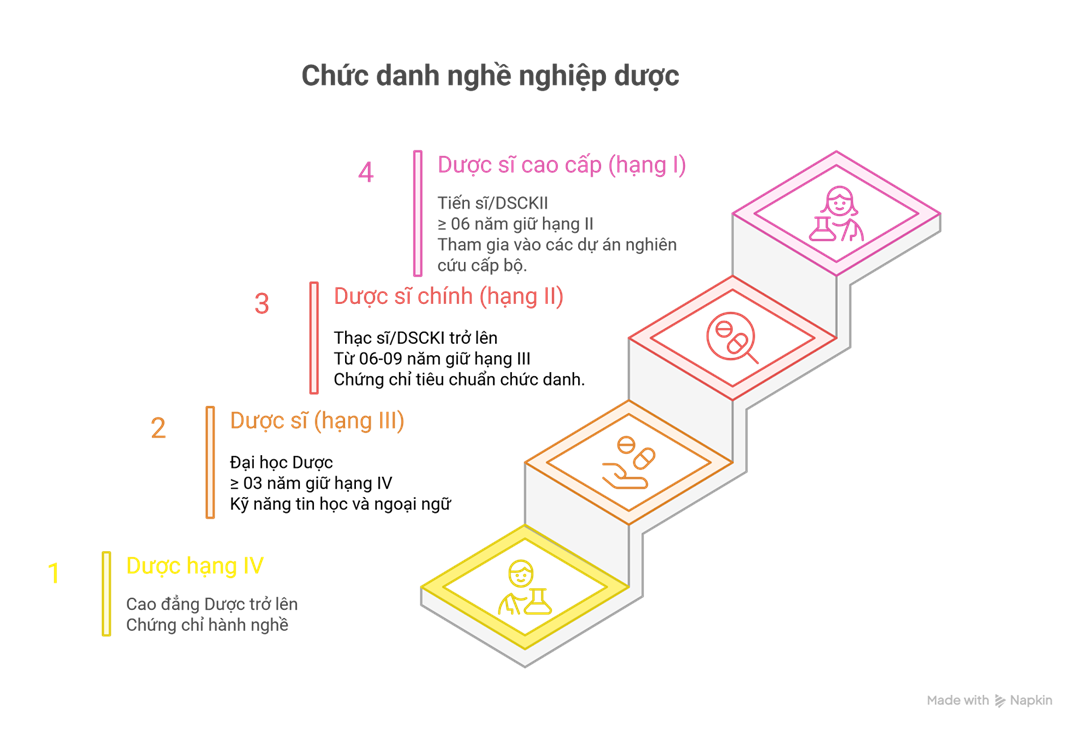
1. Pharmacist Grade IV (Code: V.08.08.23)
Responsibilities:
Prepare, dispense and store common medications, chemicals and medical supplies.
Assist in preparing simple medications and traditional Chinese medicine.
Assist higher-ranking pharmacists in specialized medication preparation.
Participate in biochemical testing and drug testing.
Record, compile statistics and report on drug side effects.
Manage records, drug inventory and compile reports.
Role:
Position of a pharmaceutical technician. Work in the dispensing warehouse, pharmacy, or assist senior pharmacists.
2. Pharmacist (Grade III) (Code: V.08.08.22)
Responsibilities:
Produce, store, dispense and use medications within facilities.
Prepare medications according to the requirements of each section.
Supervise prescription and rational medication use.
Ensure the quality of prepared medications.
Monitor and report adverse drug reactions (ADRs) and drug resistance.
Participate in the development of technical procedures and guidelines for the use of specialized equipment.
Role:
Head Pharmacist. Assigned to the Pharmacy Department, pharmacy, clinical pharmacy and drug warehouse.
3. Principal Pharmacist (Grade II) (Code: V.08.08.21)
Responsibilities:
Lead professional activities in the Pharmacy Department.
Manage drug supply, bidding and monitoring rational drug use.
Check drug quality and compounding procedures.
Train new pharmacists and interns.
Lead statistical reporting and pharmacovigilance.
Participate in consultations and antibiotic control.
Role:
Middle-manager pharmacist. May be a team leader or deputy head of the Pharmacy Department.
4. Senior Pharmacist (Grade I) (Code: V.08.08.20)
Responsibilities:
Lead all pharmaceutical activities in the hospital.
Develop and supervise the implementation of professional regulations on pharmacy.
Lead ministerial-level scientific research projects.
Manage pharmaceutical equipment and facilities.
Supervise and evaluate the professional activities of lower-level facilities.
Advise the hospital director on pharmaceutical matters.
Role:
Head of the Pharmacy Department or senior specialist. Leadership and coordination of all pharmaceutical work at the facility.
Summary of qualification requirements:
Pharmacist Grade IV: College degree in Pharmacy, no experience required, professional practice certificate needed.
Pharmacist (Grade III): University degree in Pharmacy, ≥ 3 years holding Grade IV or equivalent professional title (including ≥ 1 year in Grade IV Pharmacy), basic computer and foreign language skills required.
Principal Pharmacist (Grade II): ≥ 9 years for Master's/Specialist Pharmacist Level I and ≥ 6 years for Doctorate/Specialist Pharmacist Level II holding Grade III or equivalent professional title (including ≥ 1 year as a Grade III Pharmacist), requires a professional title standard certificate.
Senior Pharmacist (Grade I): Doctorate/Specialist Pharmacist Level II in Pharmacy, ≥ 6 years holding Grade II or equivalent professional title (including ≥ 1 year as a Grade II Pharmacist), participation in research projects at the ministerial level or higher.
*Note:
See also Joint Circular 27/2015/TTLT-BYT-BNV and Circular 03/2022/TT-BYT
